

Single Origin vs Blend Coffee Comparison
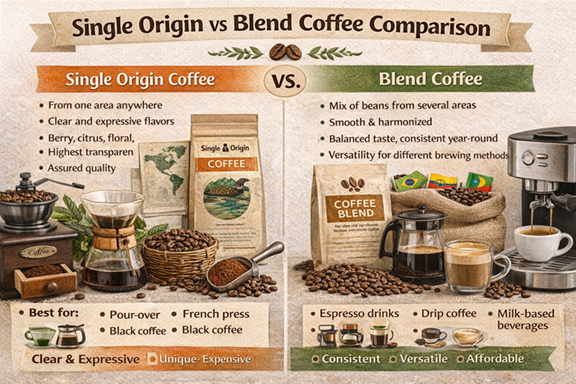
Coffee is more than a daily habit; it is an everyday ritual and a source of comfort and passion for Canadians everywhere. For whatever reason, whether you are brewing your coffee that morning or where you purchase that new cup of coffee from your favourite local coffee shop, you want to know that you are purchasing the very best cup of coffee.
Sometimes, one of the biggest questions that people who enjoy coffee want an answer to is what is single origin vs. blend coffee is. Let us explain.
What is Single Origin Coffee?
Single-origin coffee beans are obtained from one geographical area. It may be one country, one region, or in some cases, one farm. The fact that all the beans are obtained from one area means that all the beans have the same environmental conditions, which include soil, climate, and altitude.
And this is why single-origin espresso is said to be expressive with a distinct character, too, because you might pick up fruit, floral, citrus, or even wine flavors depending on the origin of the beans.
Connoisseurs would typically appreciate single-origin espresso because single origin espresso has a distinct taste because of its geographical origins.
Benefits of Single Origin Coffee
Clear distinction in flavors
Flavors become easier to isolate, and they are bolder.
Transparency
You may be aware exactly where your coffee originated.
Variations by season
Every harvest produces a slightly different taste, allowing for discoveries.
Specialty quality
Single-origin coffee beans tend to be closely associated with specialty coffee beans and better quality.
Single-origin coffee is best suited for people who prefer their coffee straight and who appreciate subtle variations with each cup.
What is Blended Coffee?
Blended coffee is made by mixing coffee beans sourced from two or more countries. While the main concept of coffee blending is not to accentuate a particular flavor, it is intended to ensure the coffee tastes consistent.
The roaster carefully chooses to utilize beans with complementary tastes—for instance, one bean for its body, one for its sweetness, and one for its mild acidity. This creates an impressively well-structured yet approachable taste that is consistent throughout the year.
Blended Coffee Profiles
Balanced taste
There is an absence of predominating notes in the cup.
Consistency
The taste remains consistent from batch to batch.
Versatility
Works well across different brewing methods and drink styles.
Approachable
Great for coffee beginners and connoisseurs alike.
Blends are frequently used as a house coffee blend in coffeehouses and are a favorite for espresso and milk-based drinks.
Single Origin vs Blend Coffee Comparison
Flavour profile clarity is one of the factors where single-origin and blended coffees are vastly different.
Single Origin: Clear and Expressive
Espresso made of single-origin coffee has a clean flavor profile. As all coffee beans are of a particular origin, there’s nothing to suppress their natural flavor. This helps to differentiate flavors like berry, citrus, honey, floral, and more.
For many coffee drinkers, such clarity can turn drinking coffee into something of an experience—almost akin to sipping wine or eating chocolate.
Blends: Smooth and Harmonized
Blends, on the other hand, have a smooth, well-balanced taste. Rather than focusing on a single dominant note, blends are designed to mix several flavors.
Blends can be easier to consume daily, particularly for people looking for a comforting, familiar cup. If you tend to enjoy milk or sugar in your coffee, a blended coffee may perform well for you because of its well-balanced flavor.
Brewing Differences: What Works Best?
Methods of brewing coffee may determine whether single-origin coffee is better or whether a blend would be advisable.
Best Brewing Methods for Single Origin Coffee
Pour-over methods, such as V60 or Chemex to highlight flavor clarity
French press for full body while retaining distinctive characters
Black coffee, without milk or sugar, to appreciate complexity
Best Brewing Methods for Blends
Espresso machines for consistent shots
Automatic drip coffee makers for daily use
Milk-based beverages such as lattes and cappuccinos
Single-origin coffees may sometimes be more particular about grind size and water temperature than blends. Blends are likely to be more flexible.
Price and Accessibility in Canada
In Canada, single-origin coffee tends to be more expensive because of its rarity and limited availability. They are often sold by specialty coffee roasters and found in specialty cafés.
Blends tend to be cheaper because they are made in bulk using beans sourced from various places. They therefore provide very good value for money.
Neither option is necessarily “better.” It simply depends on whether you value exploration or consistency more.
Which One Should You Choose?
Choose Single Origin Coffee if:
You like sampling complex flavors
You take coffee black
You’re interested in coffee origins and stories
You enjoy trying something different every season
Choose Blended Coffee if:
You want a steady daily cup
You enjoy milk-based drinks
You prefer smooth, balanced flavors
You want something easy to brew
In most Canadian coffee circles, people enjoy both a blend for busy days and a single origin for slow, relaxed moments.
FAQ: Genuine Queries from Coffee Lovers
Q1: Is single-origin coffee stronger compared to blended coffee?
Ans: No, not necessarily. Strength depends on roast level and preparation method, not origin. Single origins may taste brighter, while blends may feel smoother.
Q2: Why does single-origin coffee taste different each time?
Ans: Because it’s seasonal. Weather conditions and harvest variations can subtly affect flavor from one season to the next.
Q3: Are blends lower quality than single-origin coffee?
Ans: No. A well-crafted blend can be just as high quality. Blending is a skill, not a shortcut.
Q4: Which is better for beginners?
Ans: Blends are typically more approachable for beginners because they are more forgiving and familiar in flavor.
Q5: Can single-origin coffee be used for espresso?
Ans: Yes, but it may taste brighter or more acidic. This is why many cafés prefer blends for espresso-based drinks.
The single origin vs blend coffee discussion is not about choosing a winner; it’s about understanding what best suits your taste and lifestyle. Single-origin coffee offers purity, clarity, and a sense of place, while blends deliver balance, comfort, and consistency.


Comments